
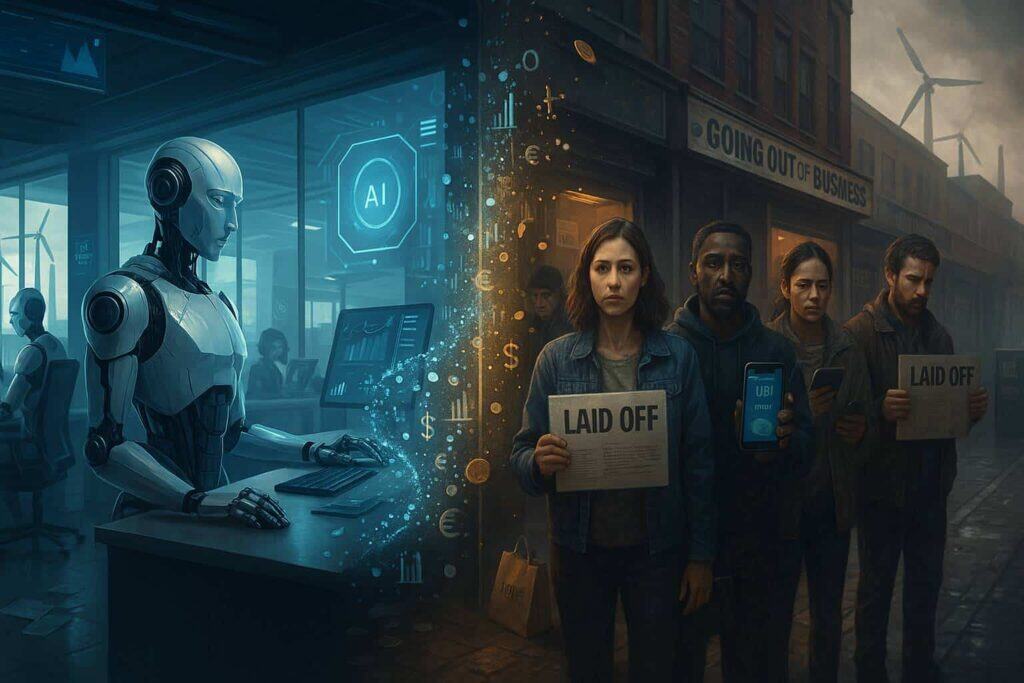
The world economy is standing at a crossroads. AI and robotics promise major efficiency gains, but they’re also shaking up how work itself functions. Jobs are being redefined or erased, and as that happens, consumer spending power is quietly being hollowed out. Add the growing talk about Universal Basic Income (UBI) and the costs of carbon reduction, and you can see the early signs of a global squeeze on disposable income… one that will shape how people live, spend, and work for years to come.
⚙️ The Layoff Acceleration: A Tale of Two Speeds
The current wave of layoffs paints a clear picture.
According to layoffs.fyi, more than 112,000 tech employees have lost their jobs across 218 companies. That’s just the tech world… and it’s only the documented cases.
Take a look at some examples:
-
Amazon is cutting up to 30,000 corporate jobs, according to Reuters in October 2025.
-
Target has laid off 1,800 corporate staff, its biggest reduction in a decade.
-
Microsoft has trimmed around 9,000 employees in its latest round.
But this isn’t a typical economic cycle. These companies aren’t just trimming costs… they’re restructuring permanently. Human work is being replaced by machine work. Cognitive tasks are being done by AI. Physical labor is being automated by robots.
The industries closest to automation are seeing the biggest shocks first… while others are slowly being pulled into the same current. Manufacturing, customer service, data entry, content moderation, routine coding, and even parts of creative work are being absorbed at an accelerating pace.
💰 The UBI Paradox: Security Without Prosperity
As jobs disappear, UBI has gone from an abstract idea to a real policy discussion. Several governments have already launched small trials… and the pressure for expansion is building.
Yet here’s the paradox: UBI helps people survive, not thrive. Most proposals fall between $1,000–$1,500 a month… barely enough to cover rent, food, and bills in developed economies.
For people used to earning $60,000 to $100,000, the drop is enormous. And as more citizens rely on UBI, those still working shoulder higher taxes to fund it. Businesses, in turn, face customers who can afford less.
It’s security… but without prosperity. 🧩
🌍 Carbon Targets: The Compounding Pressure
Carbon reduction targets are vital for the planet, but they bring short-term costs that hit households hard. Energy is the backbone of everything, and as energy costs rise… so does everything else.
Transportation gets pricier. Home heating and cooling bills grow. The cost of food increases because agriculture and logistics rely on energy. Even manufactured goods become more expensive as embedded energy costs rise.
For families already dealing with lost income or stagnant wages, this creates a double hit. The result… shrinking room for anything beyond essentials.
📉 The Disposable Income Death Spiral
Put these forces together… AI-driven job cuts, modest UBI payments, and rising living costs… and a clear trend emerges.
Let’s compare:
-
2025: Two adults earn $120,000 combined, leaving around $1,500 a month for non-essentials.
-
2030 (projected): One adult working ($50,000) and one on UBI ($18,000). With costs up 25%, the leftover amount could drop to just $400–$500.
That’s a 70% drop in discretionary spending… and it’s not a worst-case scenario.
🌊 The Ripple Effect Across the Economy
Reduced spending doesn’t hit everything at once… it spreads in waves:
1️⃣ First wave… travel, luxury goods, dining, and entertainment.
2️⃣ Second wave… cars, appliances, and housing, as people delay major purchases.
3️⃣ Third wave… even basics start to feel it, as consumers trade down to cheaper brands.
4️⃣ Final wave… the service sector contracts. Restaurants, retailers, and entertainment venues close, adding more job losses and feeding the cycle.
🏢 The Business Dilemma
Companies face a painful irony. They adopt AI and robotics to stay competitive… but in doing so, they erase their own customer base.
Henry Ford once paid his workers enough to buy his cars. Today, most corporations chase quarterly gains, not ecosystem health. Each individual company’s choice makes sense on paper… but together, they create a downward spiral.
It’s a tragedy of the commons in economic form.
🧩 What Businesses Can Do
Even in this shift, businesses still hold real power to shape outcomes. Here’s how they can help rebuild balance:
-
Adopt Human-AI Collaboration Models
Instead of replacing people, design systems where AI supports workers. Use automation to remove the repetitive… not the meaningful. -
Reinvest Efficiency Gains
When AI cuts costs, reinvest some savings into wages, community projects, or customer benefits. Shared prosperity strengthens long-term demand. -
Promote Employee Ownership and Profit-Sharing
Give employees a stake in the business. Profit-sharing builds loyalty and keeps spending power in the ecosystem that sustains the brand. -
Focus on Essential Value Creation
Build products and services that meet real human needs… not just optimise shareholder returns. Businesses that serve the human side will outlast those chasing margins. -
Support Lifelong Learning and Reskilling
Help workers transition. Offer training in creative, analytical, or emotional intelligence roles that AI can’t replace. -
Adopt Local and Circular Economies
Source locally where possible. Design products for repair and reuse. Keep value cycling within communities instead of leaking to automation-driven supply chains. -
Be Transparent About AI Use
Build trust. Let consumers know where AI is used and how it benefits them, not just the company’s bottom line.
Business can still be the bridge between innovation and inclusion… but it takes intention.
🔮 Possible Futures
Optimistic Scenario 🌈
AI brings abundance. Energy becomes cheaper. Governments adapt quickly. New kinds of work appear faster than old ones vanish.
Realistic Scenario ⚖️
We face a long, difficult adjustment… shrinking spending, higher tensions, and painful transitions until society finds balance again.
Pessimistic Scenario ⚠️
A deflationary loop. Fewer jobs, less spending, more closures. Wealth concentrates at the top while the majority live with less.
🧭 What Needs to Change
-
Policy: UBI should support a dignified life, not just survival. Carbon costs must be shared fairly. Tax systems must prevent extreme wealth concentration.
-
Business: Focus on shared prosperity… profit-sharing, employee ownership, and long-term stability.
-
Individuals: Build skills that AI can’t replicate easily. Strengthen local communities. Consume less, connect more.
-
Technology: Design AI to enhance human ability… not replace it.
⏳ A Pivotal Moment
We’re living through a convergence of technology, economy, and environment. The layoffs we see at Amazon, Microsoft, and others are not isolated… they’re signs of a deeper shift.
The 112,732 tech workers laid off are just the start. Without careful planning, the world could enter a phase where machines create abundance but people can’t afford to enjoy it.
The question isn’t whether AI will transform work… it’s whether society can transform alongside it.
The next few years will decide if we build systems that share prosperity… or if we accept a future where progress leaves most people behind.
⏰ The clock is ticking. The stakes couldn’t be higher.

